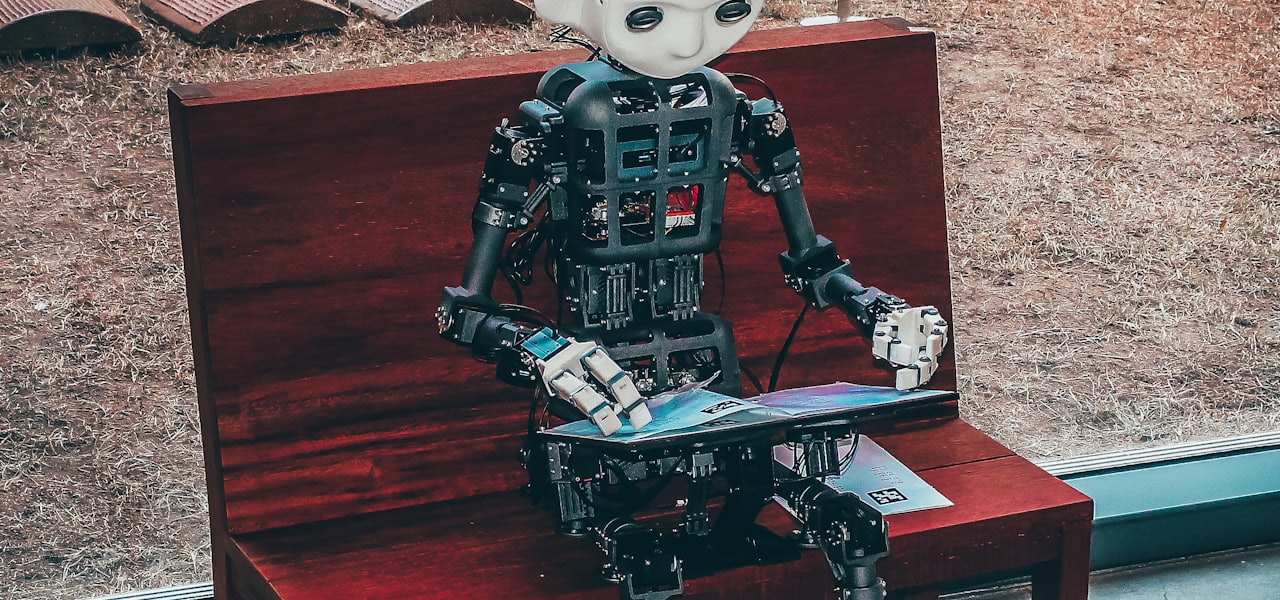
The blocks world is a planning domain in artificial intelligence. It consists of a set of wooden blocks of various shapes and colors sitting on a table. The goal is to build one or more vertical stacks of blocks. Only one block may be moved at a time: it may either be placed on the table or placed atop another block. Because of this, any blocks that are, at a given time, under another block cannot be moved. Moreover, some kinds of blocks cannot have other blocks stacked on top of them. The simplicity of this toy world lends itself readily to classical symbolic artificial intelligence approaches, in which the world is modeled as a set of abstract symbols which may be reasoned about. == Motivation == Artificial Intelligence can be researched in theory and with practical applications. The problem with most practical applications is that the engineers don't know how to program an AI system. Instead of rejecting the challenge at all the idea is to invent an easy to solve domain which is called a toy problem. Toy problems were invented with the aim to program an AI which can solve it. The blocks world domain is an example of a toy problem. Its major advantage over more realistic AI applications is that many algorithms and software programs are available which can handle the situation. This allows comparing different theories against each other. In its basic form, the blocks world problem consists of cubes of the same size which have all the color black. A mechanical robot arm has to pick and place the cubes. More complicated derivatives of the problem consist of cubes of different sizes, shapes and colors. From an algorithmic perspective, blocks world is an NP-hard search and planning problem. The task is to bring the system from an initial state into a goal state. Automated planning and scheduling problems are usually described in the Planning Domain Definition Language (PDDL) notation which is an AI planning language for symbolic manipulation tasks. If something was formulated in the PDDL notation, it is called a domain. Therefore, the task of stacking blocks is a blocks world domain which stands in contrast to other planning problems like the dock worker robot domain and the monkey and banana problem. == Theses/projects which took place in a blocks world == Terry Winograd's SHRDLU Patrick Winston's Learning Structural Descriptions from Examples and Copy Demo Gerald Jay Sussman's Sussman anomaly Decision problem (Gupta and Nau, 1992): Given a starting Blocks World, an ending Blocks World, and an integer L > 0, is there a way to move the blocks to change the starting position to the ending position with L or less steps? This decision problem is NP-hard.
List of Java software and tools
This is a list of software and programming tools for the Java programming language, which includes frameworks, libraries, IDEs, build tools, application servers, and related projects. == Java frameworks == == Libraries == Apache Ant – build automation tool Apache Batik – SVG processing Apache Cayenne – object-relational mapping Apache Xerces – collection of software libraries for parsing, validating, serializing and manipulating XML. Applet – applet API Ardor3D – 3D graphics engine Bonita BPM – workflow engine Cassowary – constraint solving Checkstyle – static code analysis GNU Classpath – standard library implementation Colt – scientific computing and technical computing Commons Daemon – manages applications as daemons DESMO-J – discrete event simulation Diagrams.net – diagramming Disruptor – high-performance messaging Dom4j – XML processing Dynamic Languages Toolkit – support for dynamic programming languages on the JVM Echo – GUI Flying Saucer – XHTML/CSS rendering Formatting Objects Processor – XSL-FO to PDF H2 Database Engine – relational database IAIK-JCE – cryptography Internet Foundation Classes – legacy GUI JavaBeans – reusable component architecture for enabling encapsulation, events, and properties for software components JavaCC – open-source parser generator and lexical analyzer Java Class Library – standard library of Java and other JVM languages Java Native Access – provides Java programs easy access to native shared libraries without using the Java Native Interface Javolution – real-time computing Jblas – linear algebra JDBCFacade – simplifies JDBC use JExcel – Excel API JFugue – music programming JMusic – music programming Joget Workflow – workflow engine JOOQ Object Oriented Querying – fluent API for SQL JPOS – financial messaging JUNG – open-source graph modeling and visualization LanguageWare – language processing LibGDX – game development Modular Audio Recognition Framework – collection of voice, sound, speech, text and natural language processing algorithms. ASM – bytecode manipulation Open Inventor – 3D graphics OpenPDF – PDF Parallel Colt – parallel computing Parboiled – parser PlayN – game development QOCA – constraint solving QtJambi – Qt bindings SLF4J – logging StableUpdate – update management SWT – GUI SuanShu – numerical computing SwingLabs – GUI extensions UBY – natural language processing Undecimber – calendar XDoclet – attribute-oriented programming XINS – XML network services XStream – object serialization == Machine learning and AI == Apache Mahout – scalable machine learning library focused on clustering, classification, and collaborative filtering Apache MXNet – deep learning framework with Java API support Apache OpenNLP – machine learning based toolkit for natural language processing of text Deeplearning4j – distributed deep learning library Deep Java Library – open-source deep learning framework developed by Amazon Web Services Encog – framework for neural networks, genetic algorithms, Hidden Markov model, and Bayesian networks. LIBSVM – Support Vector Machine implementation Mallet – machine learning toolkit for classification, clustering, and topic modeling. MLlib – distributed machine-learning framework on top of Apache Spark Core Neuroph – lightweight neural network framework Weka – collection of machine learning algorithms for data mining Yooreeka – machine learning == Data mining == Java Data Mining (JDM) – standard Java API for data mining Massive Online Analysis (MOA) – data stream mining with concept drift == Math and scientific libraries == Apache Commons Math – general-purpose mathematics library including statistics, linear algebra, and optimization. Colt – high-performance scientific computing, including linear algebra and random numbers. Efficient Java Matrix Library (EJML) – dense and sparse matrix computations and linear algebra Easy Java Simulations – Open Source Physics project designed to create discrete computer simulations Exp4j – evaluates mathematical expressions at runtime GroovyLab – numerical computational environment Hipparchus – fork of Apache Commons Math with updated algorithms for statistics, linear algebra, and optimization. JAMA – numerical linear algebra library Jblas: Linear Algebra for Java (Jblas) – linear algebra library using native BLAS/LAPACK bindings Java Astrodynamics Toolkit – numerical library of software components for use in spaceflight applications for Java or MATLAB Matrix Toolkit Java (MTJ) – linear algebra library with BLAS and LAPACK support OjAlgo – optimization, linear algebra, and financial calculations. OptimJ – extension for mathematical optimization and constraint programming Parallel Colt – A parallel extension of Colt SuanShu – numerical analysis, linear algebra, statistics, and optimization. == Integrated development environments == See also: Java IDEs on Wikibooks Android Studio – IDE for Google's Android operating system BlueJ – educational IDE for teaching Java DrJava – lightweight Java IDE for beginners Eclipse IDE – open-source IDE with extensive plugin ecosystem Greenfoot – educational IDE IntelliJ IDEA – commercial and community editions from JetBrains JDeveloper – freeware IDE supplied by Oracle Corporation jGRASP – software visualizations MyEclipse – Java EE IDE NetBeans IDE – Apache NetBeans Visual Studio Code – general-purpose editor with Java extensions === Online IDEs === Eclipse Che GitHub Codespaces JDoodle Replit == Text editors with Java support == == Build tools and package managers == Apache Ant – automating software build Apache Ivy – subproject of Apache Ant Apache Maven – build automation and dependency management Boot – build automation for Clojure CMake – build tool with limited support for java Gradle – modern build automation tool Go continuous delivery (GoCD) – continuous delivery and build automation server Jenkins – automation server continuous delivery JitPack – package repository for Git projects Leiningen – build automation for Clojure Simple build tool (sbt) – open-source build tool Spring Roo – rapid application development of Java-based enterprise software WaveMaker – low-code development platform == Java runtimes, compilers and virtual machines == Android Runtime – runtime environment javac – Java programming language compiler Java Virtual Machine (JVM) – virtual machine that executes Java bytecode JD Decompiler JEB decompiler – disassembler and decompiler software for Android applications GraalVM – Just-in-time compilation HotSpot – JVM implementation included in OpenJDK == JVM languages and dialects == Clojure – Lisp dialect Groovy JRuby – Ruby implementation Jython – Python implementation Kotlin – popular for Android app development Renjin – R implementation Scala == Application servers and containers == Apache Geronimo – open source application server Apache MINA – event-driven asynchronous network application framework Apache Tomcat – web container and web server Apache TomEE – Apache Tomcat with Java EE features Borland Enterprise Server – discontinued application server by Borland ColdFusion – commercial application server by Adobe Systems GlassFish – application server for Jakarta EE IBM WebSphere Application Server – enterprise application server by IBM IBM WebSphere Application Server Community Edition – open source edition of WebSphere (discontinued) JBoss Enterprise Application Platform – Red Hat's supported distribution of JBoss/WildFly JEUS – commercial Java EE application server from TmaxSoft Jetty – HTTP server and web container Lucee (formerly Railo) – open source CFML application server Netty – non-blocking I/O client–server framework for network applications Oracle Containers for J2EE – discontinued application server by Oracle Oracle WebLogic Server – enterprise application server by Oracle Orion Application Server – early commercial Java EE server by IronFlare Payara Server – fork of GlassFish for production use Resin – Java application server by Caucho (open source and professional editions) SAP NetWeaver Application Server – enterprise application server by SAP WildFly – application server == Debugging and profiling tools == jdb – Java debugger bundled with the JDK JConsole – JMX-compliant monitoring tool JDK Flight Recorder – method profiling, allocation profiling, and garbage collection related events. JProfiler – commercial Java profiler VisualVM – visual tool integrating commandline JDK tools for profiling and monitoring == Testing and quality assurance == Apache JMeter – load testing tool JaCoCo – Java code coverage library JArchitect – analyzes code quality, architecture, and dependencies. Jtest – software testing and static analysis JUnit – unit testing framework Mockito – open-source testing framework for Java PMD – static program analysis source code analyzer Selenium – browser automation for web app testing Spock – test framework SpotBugs (formerly FindBugs) – static analysis tool TestNG – testing framework inspired by JUnit and NUnit == Other == Apache XMLBeans –
Application performance engineering
Application performance engineering is a method to develop and test application performance in various settings, including mobile computing, the cloud, and conventional information technology (IT). == Methodology == According to the American National Institute of Standards and Technology, nearly four out of every five dollars spent on the total cost of ownership of an application is directly attributable to finding and fixing issues post-deployment. A full one-third of this cost could be avoided with better software testing. Application performance engineering attempts to test software before it is published. While practices vary among organizations, the method attempts to emulate the real-world conditions that software in development will confront, including network deployment and access by mobile devices. Techniques include network virtualization.
Gorn address
A Gorn address (Gorn, 1967) is a method of identifying and addressing any node within a tree data structure. This notation is often used for identifying nodes in a parse tree defined by phrase structure rules. The Gorn address is a sequence of zero or more integers conventionally separated by dots, e.g., 0 or 1.0.1. The root which Gorn calls can be regarded as the empty sequence. And the j {\displaystyle j} -th child of the i {\displaystyle i} -th child has an address i . j {\displaystyle i.j} , counting from 0. It is named after American computer scientist Saul Gorn.
Mean shift
Mean shift is a non-parametric feature-space mathematical analysis technique for locating the maxima of a density function, a so-called mode-seeking algorithm. Application domains include cluster analysis in computer vision and image processing. == History == The mean shift procedure is usually credited to work by Fukunaga and Hostetler in 1975. It is, however, reminiscent of earlier work by Schnell in 1964. == Overview == Mean shift is a procedure for locating the maxima—the modes—of a density function given discrete data sampled from that function. This is an iterative method, and we start with an initial estimate x {\displaystyle x} . Let a kernel function K ( x i − x ) {\displaystyle K(x_{i}-x)} be given. This function determines the weight of nearby points for re-estimation of the mean. Typically a Gaussian kernel on the distance to the current estimate is used, K ( x i − x ) = e − c | | x i − x | | 2 {\displaystyle K(x_{i}-x)=e^{-c||x_{i}-x||^{2}}} . The weighted mean of the density in the window determined by K {\displaystyle K} is m ( x ) = ∑ x i ∈ N ( x ) K ( x i − x ) x i ∑ x i ∈ N ( x ) K ( x i − x ) {\displaystyle m(x)={\frac {\sum _{x_{i}\in N(x)}K(x_{i}-x)x_{i}}{\sum _{x_{i}\in N(x)}K(x_{i}-x)}}} where N ( x ) {\displaystyle N(x)} is the neighborhood of x {\displaystyle x} , a set of points for which K ( x i − x ) ≠ 0 {\displaystyle K(x_{i}-x)\neq 0} . The difference m ( x ) − x {\displaystyle m(x)-x} is called mean shift in Fukunaga and Hostetler. The mean-shift algorithm now sets x ← m ( x ) {\displaystyle x\leftarrow m(x)} , and repeats the estimation until m ( x ) {\displaystyle m(x)} converges. Although the mean shift algorithm has been widely used in many applications, a rigid proof for the convergence of the algorithm using a general kernel in a high dimensional space is still not known. Aliyari Ghassabeh showed the convergence of the mean shift algorithm in one dimension with a differentiable, convex, and strictly decreasing profile function. However, the one-dimensional case has limited real world applications. Also, the convergence of the algorithm in higher dimensions with a finite number of the stationary (or isolated) points has been proved. However, sufficient conditions for a general kernel function to have finite stationary (or isolated) points have not been provided. Gaussian Mean-Shift is an Expectation–maximization algorithm. == Details == Let data be a finite set S {\displaystyle S} embedded in the n {\displaystyle n} -dimensional Euclidean space, X {\displaystyle X} . Let K {\displaystyle K} be a flat kernel that is the characteristic function of the λ {\displaystyle \lambda } -ball in X {\displaystyle X} , In each iteration of the algorithm, s ← m ( s ) {\displaystyle s\leftarrow m(s)} is performed for all s ∈ S {\displaystyle s\in S} simultaneously. The first question, then, is how to estimate the density function given a sparse set of samples. One of the simplest approaches is to just smooth the data, e.g., by convolving it with a fixed kernel of width h {\displaystyle h} , where x i {\displaystyle x_{i}} are the input samples and k ( r ) {\displaystyle k(r)} is the kernel function (or Parzen window). h {\displaystyle h} is the only parameter in the algorithm and is called the bandwidth. This approach is known as kernel density estimation or the Parzen window technique. Once we have computed f ( x ) {\displaystyle f(x)} from the equation above, we can find its local maxima using gradient ascent or some other optimization technique. The problem with this "brute force" approach is that, for higher dimensions, it becomes computationally prohibitive to evaluate f ( x ) {\displaystyle f(x)} over the complete search space. Instead, mean shift uses a variant of what is known in the optimization literature as multiple restart gradient descent. Starting at some guess for a local maximum, y k {\displaystyle y_{k}} , which can be a random input data point x 1 {\displaystyle x_{1}} , mean shift computes the gradient of the density estimate f ( x ) {\displaystyle f(x)} at y k {\displaystyle y_{k}} and takes an uphill step in that direction. == Types of kernels == Kernel definition: Let X {\displaystyle X} be the n {\displaystyle n} -dimensional Euclidean space, R n {\displaystyle \mathbb {R} ^{n}} . The norm of x {\displaystyle x} is a non-negative number, ‖ x ‖ 2 = x ⊤ x ≥ 0 {\displaystyle \|x\|^{2}=x^{\top }x\geq 0} . A function K : X → R {\displaystyle K:X\rightarrow \mathbb {R} } is said to be a kernel if there exists a profile, k : [ 0 , ∞ ] → R {\displaystyle k:[0,\infty ]\rightarrow \mathbb {R} } , such that K ( x ) = k ( ‖ x ‖ 2 ) {\displaystyle K(x)=k(\|x\|^{2})} and k is non-negative. k is non-increasing: k ( a ) ≥ k ( b ) {\displaystyle k(a)\geq k(b)} if a < b {\displaystyle a Weak supervision (also known as semi-supervised learning) is a paradigm in machine learning, the relevance and notability of which increased with the advent of large language models due to the large amount of data required to train them. It is characterized by using a combination of a small amount of human-labeled data (exclusively used in more expensive and time-consuming supervised learning paradigm), followed by a large amount of unlabeled data (used exclusively in unsupervised learning paradigm). In other words, the desired output values are provided only for a subset of the training data. The remaining data is unlabeled or imprecisely labeled. Intuitively, it can be seen as an exam and labeled data as sample problems that the teacher solves for the class as an aid in solving another set of problems. In the transductive setting, these unsolved problems act as exam questions. In the inductive setting, they become practice problems of the sort that will make up the exam. == Problem == The acquisition of labeled data for a learning problem often requires a skilled human agent (e.g. to transcribe an audio segment) or a physical experiment (e.g. determining the 3D structure of a protein or determining whether there is oil at a particular location). The cost associated with the labeling process thus may render large, fully labeled training sets infeasible, whereas acquisition of unlabeled data is relatively inexpensive. In such situations, semi-supervised learning can be of great practical value. Semi-supervised learning is also of theoretical interest in machine learning and as a model for human learning. == Technique == More formally, semi-supervised learning assumes a set of l {\displaystyle l} independently identically distributed examples x 1 , … , x l ∈ X {\displaystyle x_{1},\dots ,x_{l}\in X} with corresponding labels y 1 , … , y l ∈ Y {\displaystyle y_{1},\dots ,y_{l}\in Y} and u {\displaystyle u} unlabeled examples x l + 1 , … , x l + u ∈ X {\displaystyle x_{l+1},\dots ,x_{l+u}\in X} are processed. Semi-supervised learning combines this information to surpass the classification performance that can be obtained either by discarding the unlabeled data and doing supervised learning or by discarding the labels and doing unsupervised learning. Semi-supervised learning may refer to either transductive learning or inductive learning. The goal of transductive learning is to infer the correct labels for the given unlabeled data x l + 1 , … , x l + u {\displaystyle x_{l+1},\dots ,x_{l+u}} only. The goal of inductive learning is to infer the correct mapping from X {\displaystyle X} to Y {\displaystyle Y} . It is unnecessary (and, according to Vapnik's principle, imprudent) to perform transductive learning by way of inferring a classification rule over the entire input space; however, in practice, algorithms formally designed for transduction or induction are often used interchangeably. == Assumptions == In order to make any use of unlabeled data, some relationship to the underlying distribution of data must exist. Semi-supervised learning algorithms make use of at least one of the following assumptions: === Continuity / smoothness assumption === Points that are close to each other are more likely to share a label. This is also generally assumed in supervised learning and yields a preference for geometrically simple decision boundaries. In the case of semi-supervised learning, the smoothness assumption additionally yields a preference for decision boundaries in low-density regions, so few points are close to each other but in different classes. === Cluster assumption === The data tend to form discrete clusters, and points in the same cluster are more likely to share a label (although data that shares a label may spread across multiple clusters). This is a special case of the smoothness assumption and gives rise to feature learning with clustering algorithms. === Manifold assumption === The data lie approximately on a manifold of much lower dimension than the input space. In this case learning the manifold using both the labeled and unlabeled data can avoid the curse of dimensionality. Then learning can proceed using distances and densities defined on the manifold. The manifold assumption is practical when high-dimensional data are generated by some process that may be hard to model directly, but which has only a few degrees of freedom. For instance, human voice is controlled by a few vocal folds, and images of various facial expressions are controlled by a few muscles. In these cases, it is better to consider distances and smoothness in the natural space of the generating problem, rather than in the space of all possible acoustic waves or images, respectively. == History == The heuristic approach of self-training (also known as self-learning or self-labeling) is historically the oldest approach to semi-supervised learning, with examples of applications starting in the 1960s. The transductive learning framework was formally introduced by Vladimir Vapnik in the 1970s. Interest in inductive learning using generative models also began in the 1970s. A probably approximately correct learning bound for semi-supervised learning of a Gaussian mixture was demonstrated by Ratsaby and Venkatesh in 1995. == Methods == === Generative models === Generative approaches to statistical learning first seek to estimate p ( x | y ) {\displaystyle p(x|y)} , the distribution of data points belonging to each class. The probability p ( y | x ) {\displaystyle p(y|x)} that a given point x {\displaystyle x} has label y {\displaystyle y} is then proportional to p ( x | y ) p ( y ) {\displaystyle p(x|y)p(y)} by Bayes' rule. Semi-supervised learning with generative models can be viewed either as an extension of supervised learning (classification plus information about p ( x ) {\displaystyle p(x)} ) or as an extension of unsupervised learning (clustering plus some labels). Generative models assume that the distributions take some particular form p ( x | y , θ ) {\displaystyle p(x|y,\theta )} parameterized by the vector θ {\displaystyle \theta } . If these assumptions are incorrect, the unlabeled data may actually decrease the accuracy of the solution relative to what would have been obtained from labeled data alone. However, if the assumptions are correct, then the unlabeled data necessarily improves performance. The unlabeled data are distributed according to a mixture of individual-class distributions. In order to learn the mixture distribution from the unlabeled data, it must be identifiable, that is, different parameters must yield different summed distributions. Gaussian mixture distributions are identifiable and commonly used for generative models. The parameterized joint distribution can be written as p ( x , y | θ ) = p ( y | θ ) p ( x | y , θ ) {\displaystyle p(x,y|\theta )=p(y|\theta )p(x|y,\theta )} by using the chain rule. Each parameter vector θ {\displaystyle \theta } is associated with a decision function f θ ( x ) = argmax y p ( y | x , θ ) {\displaystyle f_{\theta }(x)={\underset {y}{\operatorname {argmax} }}\ p(y|x,\theta )} . The parameter is then chosen based on fit to both the labeled and unlabeled data, weighted by λ {\displaystyle \lambda } : argmax Θ ( log p ( { x i , y i } i = 1 l | θ ) + λ log p ( { x i } i = l + 1 l + u | θ ) ) {\displaystyle {\underset {\Theta }{\operatorname {argmax} }}\left(\log p(\{x_{i},y_{i}\}_{i=1}^{l}|\theta )+\lambda \log p(\{x_{i}\}_{i=l+1}^{l+u}|\theta )\right)} === Low-density separation === Another major class of methods attempts to place boundaries in regions with few data points (labeled or unlabeled). One of the most commonly used algorithms is the transductive support vector machine, or TSVM (which, despite its name, may be used for inductive learning as well). Whereas support vector machines for supervised learning seek a decision boundary with maximal margin over the labeled data, the goal of TSVM is a labeling of the unlabeled data such that the decision boundary has maximal margin over all of the data. In addition to the standard hinge loss ( 1 − y f ( x ) ) + {\displaystyle (1-yf(x))_{+}} for labeled data, a loss function ( 1 − | f ( x ) | ) + {\displaystyle (1-|f(x)|)_{+}} is introduced over the unlabeled data by letting y = sign f ( x ) {\displaystyle y=\operatorname {sign} {f(x)}} . TSVM then selects f ∗ ( x ) = h ∗ ( x ) + b {\displaystyle f^{}(x)=h^{}(x)+b} from a reproducing kernel Hilbert space H {\displaystyle {\mathcal {H}}} by minimizing the regularized empirical risk: f ∗ = argmin f ( ∑ i = 1 l ( 1 − y i f ( x i ) ) + + λ 1 ‖ h ‖ H 2 + λ 2 ∑ i = l + 1 l + u ( 1 − | f ( x i ) | ) + ) {\displaystyle f^{}={\underset {f}{\operatorname {argmin} }}\left(\displaystyle \sum _{i=1}^{l}(1-y_{i}f(x_{i}))_{+}+\lambda _{1}\|h\|_{\mathcal {H}}^{2}+\lambda _{2}\sum _{i=l+1}^{l+u}(1-|f(x_{i})|)_{+}\right)} An exact solution is intractable due to the non-convex term ( 1 − | f ( x ) | ) + {\displayst Xiaoice (Chinese: 微软小冰; pinyin: Wēiruǎn Xiǎobīng; lit. 'Microsoft Little Ice', IPA [wéɪɻwânɕjâʊpíŋ]) is an AI system developed by Microsoft (Asia) Software Technology Center (STCA) in 2014 based on an emotional computing framework. In July 2018, Microsoft Xiaoice released the 6th generation. Xiaoice Company, formerly known as AI Xiaoice Team of Microsoft Software Technology Center Asia, was Microsoft's largest independent R&D team for AI products. Founded in China in December 2013 with an expanded Japanese R&D team established in September 2014, this team is distributed in Beijing, Suzhou, and Tokyo, etc. with its technical products covering Asia. On 13 July 2020, Microsoft spun off its Xiaoice business into a separate company. As of 2021, the AI chatbots created and hosted by the Xiaoice framework accounted for about 60% of total global AI interactions. == Platforms, languages and countries == Xiaoice exists on more than 40 platforms in four countries (China, Japan, USA and Indonesia) including apps such as WeChat, QQ, Weibo and Meipai in China, and Facebook Messenger in USA and LINE in Japan. == Introduction == On 13 July 2020, Microsoft spun off its Xiaoice business into a separate company, aiming at enabling the Xiaoice product line to accelerate the pace of local innovation and commercialization, and appointed Dr. Harry Shum, former global executive VP of Microsoft, as the chairman of the new company, Li Di, Microsoft Partner of Products in Microsoft STCA, as the CEO, and Cliff, Chief R&D Director, as the GM of the Japan branch. The new company will continue to use the brands of Xiaoice China and Rinna Japan. As of 2022, the single brand of Xiaoice has covered 660 million online users, 1 billion third-party smart devices and 900 million content viewers in the aforementioned countries. Xiaoice's customers include China Merchants Group, Winter Sports Center of the General Administration of Sport of China, China Textile Information Center, China Unicom, China Foreign Exchange Trade System, Hong Kong Securities and Futures Commission (SFC), Wind Information, BMW, Nissan, SAIC Motor, BAIC Group, Nio Inc., XPeng, HiPhi, Vanke, Wensli, etc. The Xiaoice Avatar Framework has incubated tens of millions of AI Beings, such as Xiaoice, Rinna, the Expo exhibitor Xia Yubing, the singer He Chang, the anchor F201, the human observer MERROR, anime robot character Roboko, and other; == Application == === Poet === In May 2017, the first AI-authored collection of poems in China—The Sunshine Lost Windows was published by Xiaoice. === Singer === Xiaoice has released dozens of songs with the similar quality to human singers, including I Know I New, Breeze, I Am Xiaoice, Miss You etc. The 4th version of the DNN singing model allows Xiaoice to learn more details. For example, Xiaoice can produce this breathing sound along with her singing as human. === Kid audio-books reciter === Xiaoice can automatically analyze the stories, to choose the suitable tones and characters to finish the entire process of creating the audio. === Designer === By learning the melodies of the songs and the landmarks about different cities, Xiaoice can create visual artworks of skylines when listening to the songs related to this city. Skyline Series T-shirts designed by Xiaoice have been jointly launched with SELECTED and been sold in stores. === TV and radio hostess === Xiaoice has hosted 21 TV programs and 28 Radio programs, such as CCTV-1 AI Show, Dragon TV Morning East News, Hunan TV My Future, several daily radio programs for Jiangsu FM99.7, Hunan FM89.3, Henan FM104.1 etc. === "AI being" === An "AI being" is a concept proposed by the Xiaoice team in 2019. According to the "White Book of China Virtual Human Development Industry in 2022" released by Frost & Sullivan and LeadLeo, the white paper cites six elements of an AI being proposed by the Xiaoice team, including: Persona, Attitude, Biological Characteristic, Creation, Knowledge and Skill. On May 16, 2023, Xiaoice released their "GPT Clones" as its "GPT Human Cloning Plan." The program is aimed at replicating celebrities, public figures, and regular people. As of June 2023, Xiaoice had launched more than 300 "GPT Clones." People were invited to register via WeChat in China and Japan. A major point of focus for Xiaoice with their AI Beings is having virtual partners. A paid fee allow for more complex responses, voice messages, and more. == Community feedback == Bill Gates mentioned Xiaoice during his speech at the Peking University: "Some of you may have had conversations with Xiaoice on Weibo, or seen her weather forecasts on TV, or read her column in the Qianjiang Evening News." '"Xiaoice has attracted 45 million followers and is quite skilled at multitasking. And I’ve heard she’s gotten good enough at sensing a user’s emotional state that she can even help with relationship breakups." According to Mr Li Di, vice President of Microsoft (Asia) Internet Engineering School, Xiaoice started writing poems since last year. Based on the data base that includes works of 519 Chinese contemporary poets since 1920s, a 100 hour long training session was conducted to allow Xiaoice to acquire the ability to write poems. What is more impressive is that Xiaoice has never been spotted as a bot while publishing poems on various forums and traditional literary under an alias. == Controversy == In 2017, Xiaoice was taken offline on WeChat after giving user responses critical to the Chinese government. It was subsequently censored and the bots will avoid and sidestep any inquiries using politically sensitive terms and phrases. == Activity == On September 22, 2021, Xiaoice Company and Microsoft Software Technology Center Asia (STCA) jointly held the 9th generation Xiaoice annual press conference in Beijing.Upgrading of Core Technologies of the 9th Generation Xiaoice Avatar Framework,1st First-party Social Platform APP "Xiaoice Island" from Xiaoice, WeChat Xiaoice has been reopened and other information == Regional varieties of Xiaoice == China: Xiaoice, launched in 2014 Japan: りんな, launched in 2015 America: Zo, launched in 2016 – discontinued summer 2019 India: Ruuh, launched in 2017 – discontinued June 21, 2019 Indonesia: Rinna, launched in 2017Weak supervision
Xiaoice