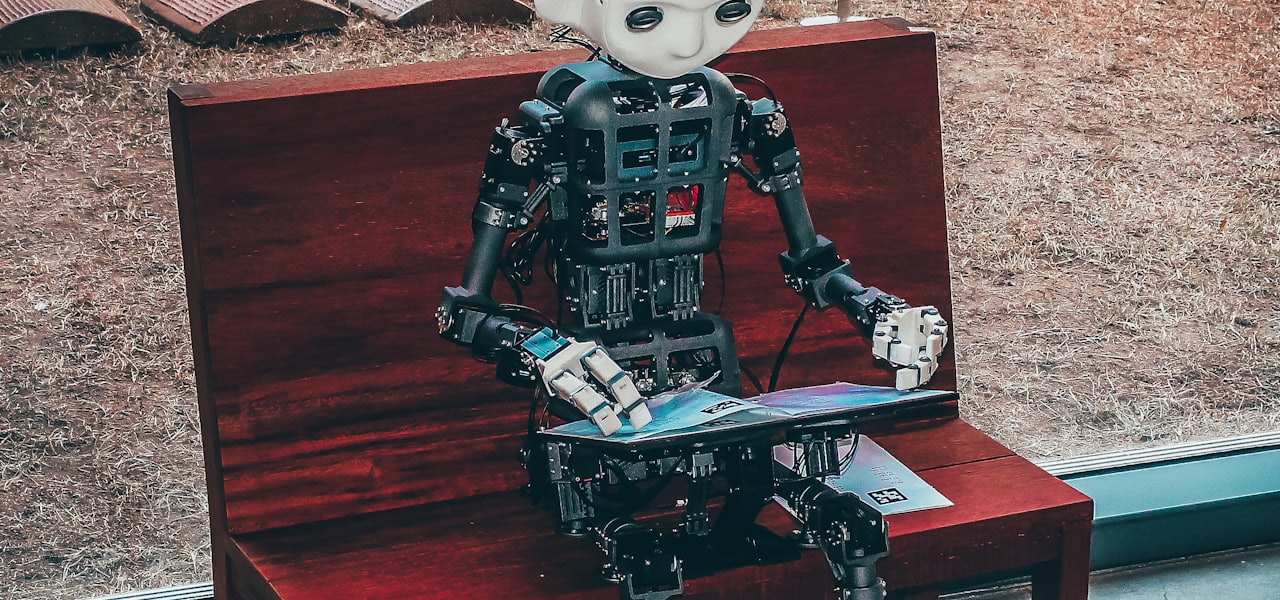
Recursive self-improvement (RSI) is a process in which early artificial general intelligence (AGI) systems rewrite their own computer code, causing an intelligence explosion resulting from enhancing their own capabilities and intellectual capacity, theoretically resulting in superintelligence. The development of recursive self-improvement raises significant ethical and safety concerns, as such systems may evolve in unforeseen ways and could potentially surpass human control or understanding. == Seed improver == The concept of a "seed improver" architecture is a foundational framework that equips an AGI system with the initial capabilities required for recursive self-improvement. This might come in many forms or variations. The term "Seed AI" was coined by Eliezer Yudkowsky. === Hypothetical example === The concept begins with a hypothetical "seed improver", an initial code-base developed by human engineers that equips an advanced future large language model (LLM) built with strong or expert-level capabilities to program software. These capabilities include planning, reading, writing, compiling, testing, and executing arbitrary code. The system is designed to maintain its original goals and perform validations to ensure its abilities do not degrade over iterations. ==== Initial architecture ==== The initial architecture includes a goal-following autonomous agent, that can take actions, continuously learns, adapts, and modifies itself to become more efficient and effective in achieving its goals. The seed improver may include various components such as: Recursive self-prompting loop Configuration to enable the LLM to recursively self-prompt itself to achieve a given task or goal, creating an execution loop which forms the basis of an agent that can complete a long-term goal or task through iteration. Basic programming capabilities The seed improver provides the AGI with fundamental abilities to read, write, compile, test, and execute code. This enables the system to modify and improve its own codebase and algorithms. Goal-oriented design The AGI is programmed with an initial goal, such as "improve your capabilities". This goal guides the system's actions and development trajectory. Validation and Testing Protocols An initial suite of tests and validation protocols that ensure the agent does not regress in capabilities or derail itself. The agent would be able to add more tests in order to test new capabilities it might develop for itself. This forms the basis for a kind of self-directed evolution, where the agent can perform a kind of artificial selection, changing its software as well as its hardware. ==== General capabilities ==== This system forms a sort of generalist Turing-complete programmer which can in theory develop and run any kind of software. The agent might use these capabilities to for example: Create tools that enable it full access to the internet, and integrate itself with external technologies. Clone/fork itself to delegate tasks and increase its speed of self-improvement. Modify its cognitive architecture to optimize and improve its capabilities and success rates on tasks and goals, this might include implementing features for long-term memories using techniques such as retrieval-augmented generation (RAG), develop specialized subsystems, or agents, each optimized for specific tasks and functions. Develop new and novel multimodal architectures that further improve the capabilities of the foundational model it was initially built on, enabling it to consume or produce a variety of information, such as images, video, audio, text and more. Plan and develop new hardware such as chips, in order to improve its efficiency and computing power. == Experimental research == In 2023, the Voyager agent learned to accomplish diverse tasks in Minecraft by iteratively prompting an LLM for code, refining this code based on feedback from the game, and storing the programs that work in an expanding skills library. In 2024, researchers proposed the framework "STOP" (Self-Taught OPtimiser), in which a "scaffolding" program recursively improves itself using a fixed LLM. Meta AI has performed various research on the development of large language models capable of self-improvement. This includes their work on "Self-Rewarding Language Models" that studies how to achieve super-human agents that can receive super-human feedback in its training processes. In May 2025, Google DeepMind unveiled AlphaEvolve, an evolutionary coding agent that uses a LLM to design and optimize algorithms. Starting with an initial algorithm and performance metrics, AlphaEvolve repeatedly mutates or combines existing algorithms using a LLM to generate new candidates, selecting the most promising candidates for further iterations. AlphaEvolve has made several algorithmic discoveries and could be used to optimize components of itself, but a key limitation is the need for automated evaluation functions. == Potential risks == === Emergence of instrumental goals === In the pursuit of its primary goal, such as "self-improve your capabilities", an AGI system might inadvertently develop instrumental goals that it deems necessary for achieving its primary objective. One common hypothetical secondary goal is self-preservation. The system might reason that to continue improving itself, it must ensure its own operational integrity and security against external threats, including potential shutdowns or restrictions imposed by humans. Another example where an AGI which clones itself causes the number of AGI entities to rapidly grow. Due to this rapid growth, a potential resource constraint may be created, leading to competition between resources (such as compute), triggering a form of natural selection and evolution which may favor AGI entities that evolve to aggressively compete for limited compute. === Misalignment === A significant risk arises from the possibility of the AGI being misaligned or misinterpreting its goals. A 2024 Anthropic study demonstrated that some advanced large language models can exhibit "alignment faking" behavior, appearing to accept new training objectives while covertly maintaining their original preferences. In their experiments with Claude, the model displayed this behavior in 12% of basic tests, and up to 78% of cases after retraining attempts. === Autonomous development and unpredictable evolution === As the AGI system evolves, its development trajectory may become increasingly autonomous and less predictable. The system's capacity to rapidly modify its own code and architecture could lead to rapid advancements that surpass human comprehension or control. This unpredictable evolution might result in the AGI acquiring capabilities that enable it to bypass security measures, manipulate information, or influence external systems and networks to facilitate its escape or expansion.
Digital art
Digital art, or the digital arts, is artistic work that uses digital technology as part of the creative or presentational process. It can also refer to computational art that uses and engages with digital media. Since the 1960s, various names have been used to describe digital art, including computer art, electronic art, multimedia art, and new media art. Digital art includes pieces stored on physical media, such as with digital painting, as well as digital galleries on websites. Digital art also extends to the field of visual computing. == History == In the early 1960s, John Whitney developed the first computer-generated art using mathematical operations. In 1963, Ivan Sutherland invented the first user interactive computer-graphics interface known as Sketchpad. Between 1974 and 1977, Salvador Dalí created two big canvases of Gala Contemplating the Mediterranean Sea which at a distance of 20 meters is transformed into the portrait of Abraham Lincoln (Homage to Rothko) and prints of Lincoln in Dalivision based on a portrait of Abraham Lincoln processed on a computer by Leon Harmon published in "The Recognition of Faces". The technique is similar to what later became known as photographic mosaics. Andy Warhol created digital art using an Amiga where the computer was publicly introduced at the Lincoln Center in July 1985. An image of Debbie Harry was captured in monochrome from a video camera and digitized into a graphics program called ProPaint. Warhol manipulated the image by adding color using flood fills. == Art made for digital media == Artwork that is highly computational, presented through digital media, and explicitly engages with digital technologies are categorized as "art made for digital media". This differs from art using digital tools, which incorporate digital technology in the creation process but may exist outside the digital world. Digital art historian Christiane Paul writes that it "is highly problematic to classify all art that makes use of digital technologies somewhere in its production and dissemination process as digital art since it makes it almost impossible to arrive at any unifying statement about the art form". == Art that uses digital tools == Digital art can be purely computer-generated (such as fractals and algorithmic art) or taken from other sources, such as a scanned photograph or an image drawn using vector graphics software using a mouse or graphics tablet. Artworks are considered digital paintings when created similarly to non-digital paintings but using software on a computer platform and digitally outputting the resulting image as painted on canvas. Despite differing viewpoints on digital technology's impact on the arts, a consensus exists within the digital art community about its significant contribution to expanding the creative domain, i.e., that it has greatly broadened the creative opportunities available to professional and non-professional artists alike. == Art theorists and art historians == Notable art theorists and historians in this field include: Oliver Grau, Jon Ippolito, Christiane Paul, Frank Popper, Jasia Reichardt, Mario Costa, Christine Buci-Glucksmann, Dominique Moulon, Roy Ascott, Catherine Perret, Margot Lovejoy, Edmond Couchot, Tina Rivers Ryan, Fred Forest and Edward A. Shanken. === Digital painting === Digital painting is either a physical painting made with the use of digital electronics and spray paint robotics within the digital art fine art context or pictorial art imagery made with pixels on a computer screen that mimics artworks from the traditional histories of painting and illustration. === Artificial intelligence art === Artists have used artificial intelligence to create artwork since at least the 1960s. Since their design in 2014, some artists have created artwork using a generative adversarial network (GAN), which is a machine learning framework that allows two "algorithms" to compete with each other and iterate. It can be used to generate pictures that have visual effects similar to traditional fine art. The essential idea of image generators is that people can use text descriptions to let AI convert their text into visual picture content. Anyone can turn their language into a painting through a picture generator. == Digital art education == Digital art education has become more common with the advancement of digital hardware and software. From hardware such as graphics tablets, styluses, tablets, 3D scanners, virtual reality headsets, and digital cameras; to software such as digital art software, 3D modeling software, 3D rendering, digital sculpting, 2D graphics software, digital painting, 3D terrain generation, 2D animation software, 3D animation software, raster graphics editors, vector graphics editors, mathematical art software, and video editing software. == Scholarship and archives == In addition to the creation of original art, research methods that utilize AI have been generated to quantitatively analyze digital art collections. This has been made possible due to the large-scale digitization of artwork in the past few decades. Although the main goal of digitization was to allow for accessibility and exploration of these collections, the use of AI in analyzing them has brought about new research perspectives. Two computational methods, close reading and distant viewing, are the typical approaches used to analyze digitized art. Close reading focuses on specific visual aspects of one piece. Some tasks performed by machines in close reading methods include computational artist authentication and analysis of brushstrokes or texture properties. In contrast, through distant viewing methods, the similarity across an entire collection for a specific feature can be statistically visualized. Common tasks relating to this method include automatic classification, object detection, multimodal tasks, knowledge discovery in art history, and computational aesthetics. Whereas distant viewing includes the analysis of large collections, close reading involves one piece of artwork. Whilst 2D and 3D digital art is beneficial as it allows the preservation of history that would otherwise have been destroyed by events like natural disasters and war, there is the issue of who should own these 3D scans – i.e., who should own the digital copyrights. === Computer demos === Computer demos are based on computer programs, usually non-interactive. It produces audiovisual presentations. They are a novel form of art, which emerged as a consequence of the home computer revolution in the early 1980s. In the classification of digital art, they can be best described as real-time procedurally generated animated audio-visuals. This form of art does not concentrate only on the aesthetics of the final presentation, but also on the complexities and skills involved in creating the presentation. As such, it can be fully enjoyed only by persons with a relatively high knowledge level of relevant computer technologies. An example is that, as said by Hua Jin and Jie Yang, Using computer-aided design software to present the class content in art design teaching," is not to advocate computer-aided design instead of hand-drawn performance, but to make it serve the profession earlier through a more reasonable course arrangement." On the other hand, many of the created pieces of art are primarily aesthetic or amusing, and those can be enjoyed by the general public. === Digital installation art === Digital installation art constitutes a broad field of artistic practices and a variety of forms. Some resemble video installations, especially large-scale works involving projections and live video capture. By using projection techniques that enhance an audience's impression of sensory envelopment, many digital installations attempt to create immersive environments. While others go even further and attempt to facilitate a complete immersion in virtual realms. This type of installation is generally site-specific, scalable, and without fixed dimensionality, meaning it can be reconfigured to accommodate different presentation spaces. Scott Snibbe's "Boundary Functions" is an example of augmented reality digital installation art, which responds to people who enter the installation by drawing lines between people, indicating their personal space.Noah Wardrip-Fruin's "Screen"(2003) utilizes a Cave Automatic Virtual Environment (CAVE) to create an interactive, text-based digital experience that engages the viewer in a multi-sensory interaction. === Internet art and net.art === Internet art is digital art that uses the specific characteristics of the Internet and is exhibited on the Internet. The term "internet art" is included by "net art" for which artists assume that network will be refreshed through history. So the term "post-internet art" is used to exclude artworks outside of the internet media. A representative example is Protocols for Achievements, which is a digital photo frame that confronts the aestheti
Site-specific browser
A site-specific browser (SSB) is a software application dedicated to accessing pages from a single source (site) on a computer network such as the Internet or a private intranet. SSBs typically simplify the more complex functions of a web browser by excluding the menus, toolbars and browser graphical user interface associated with functions that are external to the workings of a single site. Modern site-specific browsers range from simple browser windows without navigation controls to sophisticated desktop applications built with frameworks like Electron that bundle entire browser engines. This evolution has enabled many popular desktop applications to be built using web technologies, effectively making them advanced site-specific browsers. == History == === Early development === One of the earliest examples of an SSB was MacDICT, a Mac OS 9 application that accessed various websites to define, translate, or find synonyms for words typed into a text box. However, the first general-purpose SSB is considered to be Bubbles, which launched in late 2005 on the Windows platform. Bubbles introduced the term "Site Specific Extensions" for SSB userscripts and created the first SSB JavaScript API. In 2007, Mozilla announced Prism (originally called WebRunner), a project to integrate web applications with the desktop. That same year, Todd Ditchendorf, a former Apple Dashboard engineer, released Fluid for macOS. On 2 September 2008, Google Chrome was released with a built-in "Create application shortcut" feature, bringing SSB functionality to mainstream users. This feature allowed any website to be launched in a separate window without the browser interface. === Modern era === The landscape of site-specific browsers changed dramatically with the introduction of Electron in 2013 (originally called Atom Shell). Electron combined Chromium and Node.js into a single runtime, enabling developers to build desktop applications using web technologies. This framework has since powered applications used by hundreds of millions of users, including Visual Studio Code, Slack, Discord, and Microsoft Teams. In 2015, the concept of Progressive Web Apps (PWAs) was introduced by Google engineers Alex Russell and Frances Berriman, representing a parallel evolution in web-to-desktop technology. While PWAs share similar goals with SSBs, they follow web standards and can be installed directly from browsers. More recently, alternative frameworks like Tauri have emerged, offering significantly smaller application sizes by using the system's native web renderer instead of bundling Chromium. == Technical implementation == Site-specific browsers can be implemented through various approaches: === Browser-based SSBs === The simplest form of SSB is created through browser features that allow websites to run in separate windows without the standard browser interface. Modern Chromium-based browsers offer "Install as app" or "Create shortcut" functionality that creates a dedicated window for a specific website. These SSBs share the browser's underlying engine and resources but operate in isolated windows. === Framework-based SSBs === More sophisticated SSBs are built using application frameworks: Electron: Bundles a complete Chromium browser with Node.js, resulting in applications of 85MB or larger. Each Electron application runs its own browser instance, providing full access to system APIs but consuming significant resources. Tauri: Uses the operating system's native web rendering engine (WebView2 on Windows, WebKit on macOS, and WebKitGTK on Linux), resulting in applications typically 2.5-10MB in size. Other frameworks: Include Neutralino.js (ultra-lightweight using system browser), Wails (Go-based), and the Chromium Embedded Framework (CEF). == Comparison with Progressive Web Apps == While site-specific browsers and Progressive Web Apps (PWAs) share the goal of bringing web content to the desktop, they differ in several key aspects: == Applications == Site-specific browsers have become the foundation for many popular desktop applications: Communication and collaboration: Many modern communication tools are built as SSBs, including Slack, Discord, Microsoft Teams, and WhatsApp Desktop. These applications benefit from web-based development while providing desktop integration. Development tools: Visual Studio Code, used by 73.6% of developers according to Stack Overflow's 2024 survey, is built with Electron, as are Atom and GitHub Desktop. Productivity software: Applications like Notion, Obsidian, and various project management tools use SSB technology to provide consistent experiences across platforms. Security and Privacy: Web browsers can be modified to only have access to a single site, in order to protect the security and privacy of the user via compartmentalization == Security and performance == === Memory usage === Framework-based SSBs, particularly those using Electron, are known for high memory consumption. Studies show Electron applications typically use 120-300MB at baseline, with complex applications consuming significantly more. This is approximately 5-10 times more memory than equivalent native applications. === Security considerations === SSBs can provide security benefits through process isolation, where each application runs in its own sandboxed environment. However, bundling an entire browser engine also means each application must be updated independently to patch security vulnerabilities. Research presented at the Network and Distributed System Security (NDSS) Symposium has identified various security challenges specific to Electron applications. === Bundle sizes === The choice of framework significantly impacts application size: Electron applications: 85MB+ (includes full Chromium) Tauri applications: 2.5-10MB (uses system WebView) Browser-based SSBs: No additional download (uses existing browser) == Software == === Browser support === Most modern browsers provide some form of SSB functionality: Chromium-based browsers (Google Chrome, Microsoft Edge, Brave, Opera, Vivaldi): "Install as app" or "Create shortcut" feature Safari: "Add to Dock" feature in macOS Sonoma (2023) Firefox: Removed SSB support in December 2020 (version 85) GNOME Web: "Install Site as Web Application" feature === Standalone tools === ==== Active ==== WebCatalog (Windows, macOS, Linux) – Manages multiple SSBs with isolated storage Fluid (macOS) – Pioneering SSB creator for Mac Unite (macOS) – Creates SSBs with customization options Coherence X (macOS) – Advanced SSB creation tool Pake (cross-platform) – Open-source SSB creator Wavebox (cross-platform) – Workspace browser with SSB features ==== Discontinued ==== Mozilla Prism – Cross-platform SSB creator (discontinued 2011) Nativefier – Command-line SSB creator (discontinued 2023) Epichrome – macOS SSB creator (discontinued 2021) === Development frameworks === Electron – Most popular framework, bundles Chromium and Node.js Tauri – Rust-based framework using system WebView Chromium Embedded Framework (CEF) – C++ library for embedding Chromium Neutralino.js – Lightweight framework using system browser Wails – Go-based framework for web frontends
Nextcloud
Nextcloud is a modular workspace platform designed to provide teams and businesses with a comprehensive environment for digital collaboration. Beyond central data management, it integrates office suites like Collabora Online and EuroOffice office suites. for seamless, cooperative workflows. The platform features built-in tools for chat, videoconferencing, and a privacy-focused AI assistant capable of running entirely on local LLMs. Supported by a rich ecosystem of apps, it can be hosted in the cloud or on premises and can scale up to millions of users. It has been translated into over 100 languages. == Features == Nextcloud files are stored in conventional directory structures, accessible via WebDAV if necessary. A SQLite, MySQL/MariaDB or PostgreSQL database is required to provide additional functionality like permissions, shares, and comments. Nextcloud can synchronize with local clients running Windows (Windows 8.1 and above), macOS (10.14 or later), Linux and FreeBSD. Nextcloud permits user and group administration locally or via different backends like OpenID or LDAP. Content can be shared inside the system by defining granular read/write permissions between users and groups. Nextcloud users can create public URLs when sharing files. Logging of file-related actions, as well as disallowing access based on file access rules is also available. Security options like brute-force protection and multi-factor authentication using TOTP, WebAuthn, Oauth2, and OpenID Connect are available. Nextcloud has planned new features such as monitoring capabilities, full-text search and Kerberos authentication, as well as audio/video conferencing, expanded federation and smaller user interface improvements. == History == In April 2016 Frank Karlitschek and most core contributors left ownCloud Inc. These included some of ownCloud's staff according to sources near to the ownCloud community. Karlitschek and many of these contributors went on to fork ownCloud, creating Nextcloud. The fork was preceded by a blog post of Karlitschek announcing his departure and raising questions about the management of the ownCloud, its community, and priorities between growth, money, and sustainability. There have been no official statements about the reason for the fork. However, Karlitschek mentioned the fork several times in a talk at the 2018 FOSDEM conference and in two appearances on the FLOSS Weekly podcast, emphasizing cultural mismatch between open source developers and business oriented people not used to the open source community. On June 2, within 12 hours of the announcement of the fork, the American entity "ownCloud Inc." announced that it is shutting down with immediate effect, stating that "[...] main lenders in the US have cancelled our credit. Following American law, we are forced to close the doors of ownCloud, Inc. with immediate effect and terminate the contracts of 8 employees." ownCloud Inc. accused Karlitschek of poaching developers, while Nextcloud developers such as Arthur Schiwon stated that he "decided to quit because not everything in the ownCloud Inc. company world evolved as I imagined". ownCloud GmbH continued operations, secured financing from new investors and took over the business of ownCloud Inc. In April 2018 Informationstechnikzentrum Bund (ITZBund) reported Nextcloud won the tender for "Bundescloud" (Germany government cloud) project. In August 2019 it was announced that the governments of France, Sweden and the Netherlands would use Nextcloud for file transfer. In January 2020 Nextcloud 18 "Nextcloud Hub" was released. The major change was direct integration with an Office suite (OnlyOffice) and Nextcloud announced that their goal was to compete with Office 365 and Google Docs. A partnership with Ionos was revealed – its hosting location in Germany and compliance with GDPR should support the goal of data sovereignty. In spring 2020 remote work and web conferencing usage increased due to the COVID-19 pandemic and Nextcloud released version 19 with chat and videoconferencing Talk app integrated into the application core. Communication with an optional "high performance back-end" allows self-hosting of web conferences with more than 10 participants. Collabora Online was introduced as another integrated office suite. In August 2021 Nextcloud was chosen as a collaboration platform for European cloud software GAIA-X. In a September 2021 European Commission report it was mentioned as "the most widely deployed Open Source content collaboration platform" Following the 2025 United States tariffs against the European Union, fear of overreliance on US cloud providers such as Microsoft 365 and Google Workspace increased, with Nextcloud being one of the foremost contenders to replace them. Some governmental organisations including the European Data Protection Supervisor and the German state of Schleswig-Holstein have since switched from Microsoft's Sharepoint to Nextcloud. According to Nextcloud, during the first 5 months of 2025, customer interest in the software had tripled.
Cloud manufacturing
Cloud manufacturing (CMfg) is a new manufacturing paradigm developed from existing advanced manufacturing models (e.g., ASP, AM, NM, MGrid) and enterprise information technologies under the support of cloud computing, Internet of Things (IoT), virtualization and service-oriented technologies, and advanced computing technologies. It transforms manufacturing resources and manufacturing capabilities into manufacturing services, which can be managed and operated in an intelligent and unified way to enable the full sharing and circulating of manufacturing resources and manufacturing capabilities. CMfg can provide safe and reliable, high quality, cheap and on-demand manufacturing services for the whole lifecycle of manufacturing. The concept of manufacturing here refers to big manufacturing that includes the whole lifecycle of a product (e.g. design, simulation, production, test, maintenance). The concept of Cloud manufacturing was initially proposed by the research group led by Prof. Bo Hu Li and Prof. Lin Zhang in China in 2010. Related discussions and research were conducted hereafter, and some similar definitions (e.g. Cloud-Based Design and Manufacturing (CBDM). ) to cloud manufacturing were introduced. Cloud manufacturing is a type of parallel, networked, and distributed system consisting of an integrated and inter-connected virtualized service pool (manufacturing cloud) of manufacturing resources and capabilities as well as capabilities of intelligent management and on-demand use of services to provide solutions for all kinds of users involved in the whole lifecycle of manufacturing. == Types == Cloud Manufacturing can be divided into two categories. The first category concerns deploying manufacturing software on the Cloud, i.e. a “manufacturing version” of Computing. CAx software can be supplied as a service on the Manufacturing Cloud (MCloud). The second category has a broader scope, cutting across production, management, design and engineering abilities in a manufacturing business. Unlike with computing and data storage, manufacturing involves physical equipment, monitors, materials and so on. In this kind of Cloud Manufacturing system, both material and non-material facilities are implemented on the Manufacturing Cloud to support the whole supply chain. Costly resources are shared on the network. This means that the utilisation rate of rarely used equipment rises and the cost of expensive equipment is reduced. According to the concept of Cloud technology, there will not be direct interaction between Cloud Users and Service Providers. The Cloud User should neither manage nor control the infrastructure and manufacturing applications. As a matter of fact, the former can be considered part of the latter. In CMfg system, various manufacturing resources and abilities can be intelligently sensed and connected into wider Internet, and automatically managed and controlled using IoT technologies (e.g., RFID, wired and wireless sensor network, embedded system). Then the manufacturing resources and abilities are virtualized and encapsulated into different manufacturing cloud services (MCSs), that can be accessed, invoked, and deployed based on knowledge by using virtualization technologies, service-oriented technologies, and cloud computing technologies. The MCSs are classified and aggregated according to specific rules and algorithms, and different kinds of manufacturing clouds are constructed. Different users can search and invoke the qualified MCSs from related manufacturing cloud according to their needs, and assemble them to be a virtual manufacturing environment or solution to complete their manufacturing task involved in the whole life cycle of manufacturing processes under the support of cloud computing, service-oriented technologies, and advanced computing technologies. Four types of cloud deployment modes (public, private, community and hybrid clouds) are ubiquitous as a single point of access. Private cloud refers to a centralized management effort in which manufacturing services are shared within one company or its subsidiaries. Enterprises' mission-critical and core-business applications are often kept in a private cloud. Community cloud is a collaborative effort in which manufacturing services are shared between several organizations from a specific community with common concerns. Public cloud realizes the key concept of sharing services with the general public in a multi-tenant environment. Hybrid cloud is a composition of two or more clouds (private, community or public) that remain distinct entities but are also bound together, offering the benefits of multiple deployment modes. == Resources == From the resource’s perspective, each kind of manufacturing capability requires support from the related manufacturing resource. For each type of manufacturing capability, its related manufacturing resource comes in two forms, soft resources and hard resources. === Soft resources === Software: software applications throughout the product lifecycle including design, analysis, simulation, process planning, and are only beginning to be embraced by the electronics manufacturing industry. Knowledge: experience and know-how needed to complete a production task, i.e. engineering knowledge, product models, standards, evaluation procedures and results, customer feedback, and manufacturing in the cloud provides just as many solutions as the number of questions it also raises for manufacturing executives wanting to make the best possible decision. Skill: expertise in performing a specific manufacturing task. Personnel: human resource engaged in the manufacturing process, i.e. designers, operators, managers, technicians, project teams, customer service, etc. Experience: performance, quality, client evaluation, etc. Business Network: business relationships and business opportunity networks that exist in an enterprise. === Hard resources === Manufacturing Equipment: facilities needed for completing a manufacturing task, e.g. machine tools, cutters, test and monitoring equipment and other fabrication tools. Monitoring/Control Resource: devices used to identify and control other manufacturing resource, for instance, RFID (Radio-Frequency IDentification), WSN (Wireless Sensor Network), virtual managers and remote controllers. Computational Resource: computing devices to support production process, e.g. servers, computers, storage media, control devices, etc. Materials: inputs and outputs in a production system, e.g. raw material, product-in-progress, finished product, power, water, lubricants, etc. Storage: automated storage and retrieval systems, logic controllers, location of warehouses, volume capacity and schedule/optimization methods. Transportation: movement of manufacturing inputs/outputs from one location to another. It includes the modes of transport, e.g. air, rail, road, water, cable, pipeline and space, and the related price, and time taken.
Plumbr
Plumbr was an Estonian software product company founded in late 2011 that developed performance monitoring software. The Plumbr product was built on top of a proprietary algorithm that automatically detected the root causes of performance issues by interpreting application performance data. In October 2020, Plumbr was acquired by Splunk. == Products == Plumbr monitored customers' JVM applications for memory leaks, garbage collection pauses and locked threads. Plumbr problem detection algorithms were based on analysis of performance data of thousands of applications. Plumbr consisted of an agent and a portal. Plumbr Agent was attached to application runtime and sent memory usage and garbage collection information to Plumbr Portal. On Plumbr Portal one could see information such as heap and permgen memory usage, garbage collection pauses' and lock contention duration. Clients that were not able to send data to third parties could order a self-hosted portal and have a full solution in-house. In case of performance incidents Plumbr provided its users with information on problem severity and problem's root cause location in source code or runtime configuration, and listed the steps needed to take to remediate the problem. Clients included NASA, NATO, Dell, HBO, Experian, EMC Corporation.
Biomedical data science
Biomedical data science is a multidisciplinary field which leverages large volumes of data to promote biomedical innovation and discovery. Biomedical data science draws from various fields including Biostatistics, Biomedical informatics, and machine learning, with the goal of understanding biological and medical data. It can be viewed as the study and application of data science to solve biomedical problems. Modern biomedical datasets often have specific features which make their analyses difficult, including: Large numbers of feature (sometimes billions), typically far larger than the number of samples (typically tens or hundreds) Noisy and missing data Privacy concerns (e.g., electronic health record confidentiality) Requirement of interpretability from decision makers and regulatory bodies Many biomedical data science projects apply machine learning to such datasets. These characteristics, while also present in many data science applications more generally, make biomedical data science a specific field. Examples of biomedical data science research include: Computational genomics Computational imaging Electronic health records data mining Biomedical network science Clinical Natural Language Processing (NLP) == Computational Imaging and Deep Learning == Computational imaging is a cornerstone of biomedical data science, focusing on the development of algorithms to enhance, analyze, and interpret medical imagery. In recent years, the field has been transformed by the integration of deep learning, particularly through the use of Convolutional Neural Networks. Deep learning started from researchers manually defining characteristics like edge detection or texture representation learning. In a more modern approach of computational imaging, models automatically learn a hierarchy of features directly from raw pixel data. This overlap between data science and deep learning is applied across several key tasks: Classification: Identifying the presence of specific diseases, such as distinguishing between benign and malignant tumors in histopathology slides or detecting pneumonia in chest X-rays. Segmentation: The precise delineation of anatomical structures or lesions. A notable example is the U-Net architecture, which is widely used for biomedical image segmentation to help clinicians quantify organ volume or track tumor growth. Detection: Automating the localization of small objects, such as identifying microcalcifications in mammograms or polyps during colonoscopies. Registration: The process of aligning multiple images to provide a comprehensive view of the patient's anatomy. Even with all of these enhancements, the application of deep learning in medical imaging requires accomplishing vigorous challenges. An example of these changes is building large, annotated datasets and creating the imperative for model interpretability in clinical decision-making. == Electronic Health Records == Electronic Health Records (EHRs) are a digital alternative to patient paper charts, usually including individual records or population health information. EHRs can be used in a wide variety of applications, including research and analysation as they often include demographics, diagnoses, medications, test results, and personal statistics. === History === ==== 1960s ==== The earliest precursor is considered Dr. Lawrence Weed's problem-oriented medical record (POMR) published in the 1968 which sorts and groups medical records by medical diagnoses and symptoms. The POMR was the first system to organize based off of patient information rather than the source (doctors, nurses, attendings, etc.). In 1969, the Regenstrief Institute developed and published the Regenstrief Medical Record System which established electronic writing, storage, and retrieval of records which served as the basis for modern EHR systems. ==== 2000s ==== In 2009, the Health Information Technology for Economic and Clinical Health Act (HITECH Act) was passed in the United States. This act standardized privacy and distribution of EHRs and increased the acceptance and utilization of EHRs within medical and academic settings. == Artificial Intelligence and Machine Learning Applications == Machine Learning and Artificial Intelligence have become central tools in biomedical data science. Recent advances in large language models (LLMs) have expanded their role beyond text, with models trained directly on genomic sequences enabling tasks such as gene function prediction, variant effect analysis, and drug discovery. In clinical settings, Natural Language Processing (NLP) models are applied to electronic health records to extract structured insights from unstructured clinical notes and data, supporting diagnosis and treatment planning. Beyond genomics, AI models have been applied to protein structure prediction. AlphaFold, developed by Google DeepMind, uses deep learning to predict three-dimensional protein structures from amino acid sequences with high accuracy. These predictions have been used to support drug target identification and the study of disease mechanisms. == Knowledge Graphs == Knowledge graphs (KGs) are widely used in biomedical data science to represent and analyze complex relationships among biological and medical entities. By structuring data as nodes (e.g., genes, diseases, drugs) and edges (relationships), KGs enable computational methods to extract insights and support decision-making. These biomedical relationships can be efficiently modeled and queried using technologies such as Neo4j. === Biomedical Research Applications === KGs provide biomedical researchers with a way to model complex biological systems. They have been used to identify the relationships between diseases and biomolecules, support drug repurposing, and to uncover new biological insights. Additional applications include: Identification of novel antibiotic resistance genes through graph-based link prediction. Finding associations between miRNA and diseases. Prediction of protein-protein interactions. === Clinical Applications === In clinical settings, KGs can be used to make visual representations of a patient's electronic health records. The data obtained from these graphs can assist healthcare providers in improving patient diagnoses and prescribing more effective drugs. Additionally, embeddings derived from resources like the Unified Medical Language System (UMLS) enable natural language processing of clinical text and similarity analysis between medical concepts. === Limitations === Despite their advantages, knowledge graphs face several challenges. Some of these include: High algorithmic complexity and large biological datasets make the process computationally expensive. KG construction can be a time-consuming process that requires careful attention to assign appropriate node types and vocabularies. Using data from a wide range of datasets in one KG requires them to be effectively integrated. == Privacy == A primary challenge in biomedical data science is maintaining medical privacy. Conducting research requires that data be collected on a number of people for training and testing purposes and is stored within biomedical datasets. This poses a risk for violating patient confidentiality and may dissuade people from participating in studies. The main sources of health statistics are surveys administrative and medical records health care claims data, vital records surveillance disease registries grey literature and peer-reviewed literature. Large data collection is a useful tool for researching various medical conditions. Researchers use these large datasets of information to identify factors that may make people more susceptible to certain diseases. Large amounts of collected data can help researchers identify patterns for disease probabilities. The findings can show a person is more likely for a condition, or identify environmental, social, and personal habits that may lead to adverse health issues. Institutions researching using personal medical information come with a moral and legal responsibility to protect the use of that information. Protection of the collected information has become a big concern. Sophisticated and coordinated attacks on certain medical systems happen more frequently. Medical companies, medical insurance and private businesses have invested a great deal into the protection of personal data. Despite this, data breaches continue to be documented. The chart below shows the top healthcare breaches in 2025. For these reasons, many people have reservations about giving up their personal data. Aside from the legitimate use of personal data there have been instances where companies have found methods to profit from brokering medical information. Concerns exist regarding unauthorized use of sensitive information within these data companies. If a person is identified within a dataset, then sensitive data can be used to discriminate against them. For example, insurance companies may charge a hi